
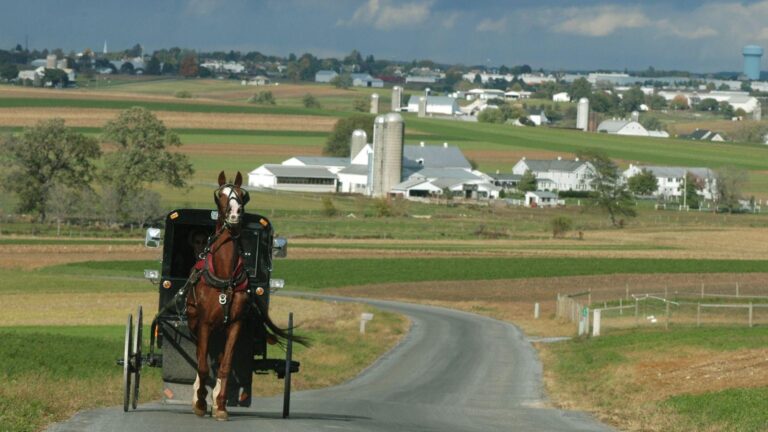
There’s a hush that falls over the countryside of Lancaster, Pennsylvania, as the morning mist lifts to reveal green fields and the rhythmic clip-clop of horse hooves on pavement. Here, time seems to move slower. Amid the rolling hills and weathered barns lives a community that has resisted the pull of modern life for more than 300 years — the Amish.
Every year, more than eight million visitors make their way to Lancaster County, drawn by a curiosity about this unique way of life. They come to see the horse-drawn buggies, taste homemade pies, and perhaps, to rediscover something lost in the noise of the modern world. Amish tourism has turned this quiet farming region into one of Pennsylvania’s most distinctive destinations — where tradition and tourism meet on winding backroads.
A Journey Back in Time The Amish arrived in Lancaster in the early 1700s, seeking religious freedom and a place to live according to their beliefs. Today, their communities are defined by simplicity, humility, and faith. Electricity, cars, and the internet are deliberately left out of daily life. Instead, Amish families rely on horse-drawn transportation, tend to fields with the help of draft horses, and gather by lantern light after sunset. Visitors can get a glimpse of this world through farm tours and buggy rides in towns like Intercourse, Bird-in-Hand, and Strasburg. The experience feels almost cinematic — open f ields dotted with laundry lines, children in straw hats walking home from school, and roadside stands offering fresh produce and warm shoofly pie.
Where Faith Meets Free Enterprise While the Amish shun advertising and self-promotion, tourism has quietly become a cornerstone of Lancaster’s economy. Many Amish families operate small businesses that align with their values — quilt-making, baking, woodworking, and farming. At markets like Central Market in downtown Lancaster, visitors can buy everything from homemade jellies and cheeses to hand carved furniture.
This intersection of faith and commerce is not without its tensions. Some worry that the influx of visitors risks turning the Amish into a “living museum.” Yet, many see tourism as an opportunity for understanding rather than exploitation. Attractions like The Amish Village and The Amish Farm and House work to educate guests about Amish beliefs, offering respectful, fact-based tours that go beyond surface stereotypes.
A Lesson in Stillness Perhaps what makes Amish Country so magnetic isn’t what it offers, but what it refuses to. In a world consumed by constant connectivity, Lancaster represents the possibility of balance — a reminder that happiness doesn’t require Wi-Fi. The silence of the countryside, the simplicity of the food, and the sense of community feel like an antidote to the modern pace of life. Visitors leave with more than souvenirs. They leave with perspective — a quiet appreciation for the beauty of simplicity and the strength it takes to hold onto one’s values in a changing world. Lancaster’s Enduring Charm Amish tourism in Lancaster isn’t just about observing another culture; it’s about reflecting on our own. The allure of this rural enclave endures because it offers something rare: authenticity. As long as visitors continue to come with curiosity and respect, Lancaster will remain a place where the past and present coexist — gently, side by side, on the backroads of Pennsylvania Dutch Country